Monday, 25 July 2011

Valerian

Valerian (Valeriana officinalis, Valerianaceæ ) is  a  herbaceous perennial native to northern Asia and Europe, it loves damp meadows, stream edges and ditches, however it does grow happily in my flower bed alongside its rather more poisonous brothers and sisters. The white to  purple umbels push skyward in the summer months, attaining a height of about three feet, and will happily stand on their own, gently towering over the mass of leaves gathering below.     
 According to Mrs Grieve; ‘The derivation of the name of this genus of plants is differently given. It is said by some authors to have been named after Valerius, who first used it in medicine; while others derive the name from the Latin word valere (to be in health), on account of its medicinal qualities.’
  It is understood to be a useful sedative, antispasmodic and carminative, and  it is said, rather contradictorily, to wake those suffering from fatigue. No doubt this is true; one sniff of the dried root could certainly wake me from slumber. I say this about very few plants, but the valerian root is rather stinky.  I sat on a bus once with some of the dried root in a brown paper bag, and the scent was so malodorous and strong that I felt compelled to remove myself and my shopping bag contents from the bus, after trying to ignore the pong to no avail. The aroma is rather similar to stale body odour, and of course, the finger could have been pointed at me and not the contents of my bag. It is probably the only plant root that I would recommend placing  in a plastic bag above a paper one, and sealing it very tightly in transit.
  It is alleged that ‘during the sixteenth century the essential oil was a popular perfume.’ (Chrissie Wildwood The Encyclopedia of Healing Plants,) It appears that the oil is extracted from the root, and so, I am presuming this has been the case throughout history; the mind just boggles at the thought. I just can’t imagine roaming the streets of London smelling of a perfume made from valerian root. Having said that, travelling on the tubes in the metropolis, on a hot steamy summer’s day,  does sometimes hold a scent as if many people have taken to this suggestion. I would encourage you to seek out some dried root and sniff; and see what I mean. No; that is rather cruel of me, please don’t.
   On a more serious note, it is also indicated to be useful in the treatment of irritable bowel syndrome, period pains, rheumatic pains and migraine, palpitations and reducing the effects caused by high blood pressure.
   Catherine Yronwode names the plant ‘Vandal Root’ and indicates that it has a ‘dual reputation for evil and protection.’ It can be used ‘to stop unwanted visitors: sprinkle VANDAL ROOT across your front steps, calling the person’s name, and commanding that he or she be unable to cross over. To make this spell stronger, add BLACK PEPPER and SALT to the mix.’ (Hoodoo Herb and Root Magic) Yep, I think if I got to some ones front door and it smelt of valerian root, I may hesitate to enter.
   A plant of the planet Mercury according to Manfred M. Junius and Ellen Evert Hoppman, yet Agrippa places valerian as under the influence of Venus, along with vervain. He states of valerian, it is that ‘which by the Arabians is called phu!’ This, according to Mrs Grieve, is ‘an expression of aversion from its offensive odour.’ Yes pooh is what I say when I open the valerian root jar. All the plants of Venus are said to be sweet scented, which may be why it has been placed under the influence of Mercury, according to more recent penmanship.
  However I find Culpeper places valerian under Mercury and Cunningham places it under Venus: so I see that theory flying out of the door along with the unwanted visitors. And then to add further confusion to my already befuddled grey matter, Donald Law places it under Uranus, and states that ‘it has been a standing ingredient of countless aphrodisiacs and love potions.’ Well I never! Not sure I see the link between love potions and Uranus though. Seeing that Uranus wasn’t identified in Culpeper’s time, it is possible that Culpeper may have agreed with Law.
   Cunningham places it as   feminine and of the element Water: with powers over love, and sleep, and also as an aid in purification and protection. He states ‘The rather ill smelling root, powdered, is used in protective sachets, hung in the home to protect against lightning, and placed in pillows to aid falling asleep’.  I could think of much nicer  aids to sleep; lavender being one of them. He goes onto say ‘A sprig of the plant pinned to a woman’s clothing will cause men to “follow her like children.” Shall I try that suggestion?.......no I think I will give it a miss.
I do feel one of the problems  with Mr Cunningham’s suggestions  is that it can become rather confusing. He has placed a comment concerning a sprig, in the middle of those for the use of the root. The flowers of valerian have a relatively pleasant scent, and the leaves appear to be odourless. However he does follow the preceding comment with; ‘Valerian root  is also added to love sachets. If a couple are quarrelling introduce some of this herb to the area and all will soon be calm.’ Ok I can see that working, as the cause of  the argument is likely to be overshadowed by trying to seek out the source of the stench.  He adds that ‘The Greeks hung a sprig of valerian under a window to charm away evil.’ Now are we talking root or plant as in flower and leaf here?
 Cunningham finishes with ‘Valerian root, powdered, is sometimes used as “graveyard dust.”’ Ooh, how can that work then?   Ellen Evert Hopman clarifies this point for me by stating that ‘It has been used as a substitute for graveyard dust to repel unwanted presences.’ Now that sounds better, doesn’t it?
  Professor Henslow gives a curious recipe, quoted in Mrs Grieve, a translation of which runs as follows: 'Men who begin to fight and when you wish to stop them, give to them the juice of Amantilla id est Valeriana and peace will be made immediately.' This sounds like a probable origin for Cunningham suggestion for calming a quarrelling couple. However it is the juice that is administered in this case.
   Mrs. Grieve caused me to stagger with amazement when she states  ‘In the Middle ages, the root was not only used as a medicine, but also as a spice, and even as a perfume.’ and then I find “Take valerian in your mouth and kiss she who you desire, and she will be yours in love right away.” (Beuchert, 1995: 31in Witchcraft Medicine) Oh yuk; do hope they mean the leaf or flower, however the previous quote does go to show how appreciation of different scents has changed over the years.


Tuesday, 19 July 2011

Greater Celandine

Greater Celandine, (Chelidonium majus) loves to grow near people, yet not quite so happily these days.  A member of the poppy family it can be found gaily roaming the hedge near farmland, not may I say, common in the vicinity of my London flat.
The greater celandine is a herbaceous perennial which  can grow to a height of between one to three feet.  Many slightly hairy branches spring from a thick and fleshy root, and shoot upwards, scrambling amongst its other hedgerow brothers and sisters. The whole plant contains a bright orange-coloured juice which is said to be a powerful irritant, and which allegedly can be used to cure warts, ringworm and corns.
    According to Mrs Grieve its appearance is of the Cruciferæ order rather than the poppy family papaveraceæ, (sounds like a load of journalists) as its four petals are arranged in the shape of a cross.  This is the true celandine, and has no relationship whatsoever with its name sake the lesser celandine, except of course ,  they both have yellow flowers. According to Mrs Grieve ‘It was a drug plant in the Middle Ages and is mentioned by Pliny, to whom we owe the tradition that is called Chelidonium from the Greek chelidon (a swallow) as  it appears that it comes into flower when the swallows arrive, and fades at their departure.’ She adds that the ‘English word Celandine is merely a corruption of the Greek word.’ (Chelidonium) She also suggests ‘Its acrid juice has been employed successfully in removing films from the cornea of the eye; a property which Pliny tells us was discovered by swallows.’(another swallow link) It appears that  that swallows were seen to pluck off celandine leaves and then rub them upon the unopened eyes of their young.  Gerard says that ‘the juice of the herbe is good to sharpen the sight, for it cleanseth and consumeth away slimie things that cleave about the ball of the eye and hinder the sight and especially being boiled with honey in a brazen vessel, as Dioscorides teacheth.’  Me thinketh, the learn-ed gentlemen copiest each other, without testing this out. I still don’t fancy putting something in my eye at the same time as I am employing this very same juice to remove warts and corns.
   Culpeper argues in support of this use of the celandine, quite emphatically, submitting that if  ‘you make celandine into an oil or an ointment,’ ‘it is one of the best cure for the eyes’ he later posits; ‘I can prove it doth both by my own experience,  and the experience of those to whom I have taught it, that most desperate sore eyes have been cured by this only medicine;’ he continues ‘I pray, is this not a far better than endangering the eyes by the art of the needle?’ Don’t like the sound of either personally! 
  So here we see (sorry for the pun) the link between the eye and the swallow. The swallow is guilty of opening the eyes of their young with celandine, therefore it must be ok. It is rather interesting to find that in many cases these suggestions stem from notes being taken from the animal and bird kingdom. However I do suggest due caution if trying a remedy just because the birds do it, after all our feathered friends happily feed on yew berries, not something that I would recommend copying.

   It is, according to Mrs G, one of the ‘twenty-four herbs mentioned in Mercer’s Herbal’ a fourteenth century work I have no idea what this is, and can find no record of it apart from this inclusion.
   Celandine is said to be good for the blood, with the old herbalists pointing to its yellow juice, and suggesting its use as a cure for jaundice; as the doctrine of signatures points to plants with yellow sap as a remedy for jaundice and liver complaints. It is found, in present days, growing in hedgerows here in the U.K,  and in Culpeper’s time it appears that it’s habitat was not dissimilar. He states ‘They grow in many places by old walls, hedges and waysides in untilled places; and being once planted in a garden, especially some shady places, it will remain there.’

   It is interesting that the above photo was taken in a hedge very near to Lullingstone Roman Villa in Kent, so the following piece of information became most fascinating to me, as evidently ‘This Eurasian herb has followed civilisation, with numerous folklore stories surrounding its uses. It was a popular herb at the height of the RomanEmpire,’   So I can playfully imagine the above specimen being a direct descendent of a Roman ancestor.

   Culpeper says of  celandine, ‘this  is an herb of the Sun’ (understandably.) He goes onto place it ‘under the Celestial Lion, and is one of the best cures for the eyes; for all that know anything in astrology, know that the eyes are subject to the luminaries; let it then be gathered when the Sun is in Leo and the Moon in Aries.’ Manfred M Junius places it under the rulership of both the Sun and Jupiter, which appears, according to Agrippa to include all things that ‘increase nourishment, and vegetation of the life.’ Although he does say ‘Amongst tastes, such as are sweat and pleasant’ Hmm, not too sure about that one. However it is probably best implied by the statement ‘all such things whose sweetness is manifest and subtle, partaking  somewhat of an astringent and sharp taste, as are nuts, almonds, pine-apples, filberts, pistachio nuts, roots of peony, myrobalan, rhubarb, and manna; Orpheus adds storax.’ however according to Junius, ‘Jovian diseases are all diseases due to immoderation in eating and drinking, bad digestion, too much congestion and impure blood.’ Back to the yellow blood again, thereby the link becomes clearer.
  
  Cunningham suggests this plant as poisonous, yet implies that celandine ‘imparts good spirits and joy if worn’ he adds the suggestion that one should wear it ‘to court to win favour of the judge or jury, or as a protective herb.’ He gives its magical uses as ‘aids in escaping unwarranted imprisonment and entrapments of every kind.’ Catherine Yronwode also places celandine as protective and indicates that it is ‘said to keep off both witches and law officers.’ Donald Law mentions that ‘The gypsies used to put the herb in their shoe and keep it there when they walked, they claimed it kept their feet fresh’ however I’ m wondering if it has anything to do with the previous suggestions; or maybe both. 

Tuesday, 12 July 2011

Blackberry

The blackberry or bramble is a very common lady here in the South East of England, as I am sure it is in other parts of the U.K, in fact there are very few places where you can wander a little from the pavement, and not become tangled in a bramble, or perhaps the bramble may become entangled in you. Very quick to try and colonise any waste ground, its tenacious branches root easily wherever they can manage to find a piece of spare earth. Straddling great heights and then diving head first towards the earth in search of fresh ground on which to take root, the blackberry often manages to construct a natural arch with many uses only limited by the imagination. In its second year of growth this cane produces lateral shoots and begins to focus on flowering and producing berries. It can do this in sun or shade, come rain or shine, on rich or very poor stony soils, but appears, as with most, to be happier with adequate supplies of sun and water, and in these conditions produce the choicest berries. Its tolerance of most conditions means that once established the bramble becomes very difficult to remove.  And in this image below is very happily growing inside this vehicle.
   A member of the rose family, all parts of the plant, root leaves, flowers and berries can be made use of, and if you would like to use the rather prickly twigs; make yourself a ‘Witches Wisk.’ (Gemma Gary, Traditional Witchcraft, A Cornish Book Of Ways, 2008)  ‘purely used to exorcise evil  and negative influences.’ Gather ‘thirteen dried blackberry twigs’ bind them together at one end 'to form a handle'. ‘The ends of the twigs are set alight in a blessed fire and the smoking whisk is waved around the place with vigorous gestures to ward off all evil and harmful influences.’ I have tried to make one, but the lacerated arms I received in the process became rather a deterrent. I will  try again and do the logical thing of donning a pair of gardening gloves, (not something I do very often) and will cover my arms; not with a favorite cardy, I hasten to add .
  The blackberry has graced these shores with her presence for many-a year. Donald Law (1973) says of the names etymology: ‘The Anglo-Saxon word was Bremel, and most of the older herbals speak of the bramble.’  He indicates that when the Latin tongue began to influence the language of England, that ‘nothing Saxon was good enough.’ so the name was changed.  Mrs Grieve on the other hand indicates that ‘the name of the bush is derived from brambel, or brymbyl, signifying prickly.’
    The blackberry is said to be a plant of  the planet Venus;    the morning and evening star,  a herald of the morning, and a bringer of light, its surface hidden in a blanket of thick cloud which provides the planet with the status of ‘ruler of occult intelligence’ and is said to be ‘strongly related to alchemy.’ (Manfred M.Junius) Junius goes onto say of Venus that ‘The planet rules the arts, harmony, proportion, affection, and the ability to integrate separate things into a whole and to mediate between opposites,’ he also points out interestingly that ‘Venus    rules over the metamorphosis of the cells,’ As an extra point of interest, it appears that Venus is the only planet to turn clockwise, all others turn anti-clockwise, not sure that that is particularly relevant here, but just thought it rather interesting.
   Culpeper suggests that the blackberry  lies under the dominion of ‘Venus in Aries’ and goes onto prompt the question; ‘If any ask the reason why Venus is so prickly? Tell them it is because she is in the house of Mars.’  Donald Law makes this a bit clearer by suggesting that ‘The plant is under the sign of Aries but held to be subject to influence by Venus.’      According to Michael Jordan (Plants of Mystery and Magic) the ‘bramble has been associated with virtue, which again, in my opinion links it with Venus.  
   Associated folklore couples the blackberry with Michaelmas, a festival celebrated somewhere between 29th of September and October the 10th, around this date it is said that the Devil was expelled from heaven by the Archangel Michael. Revelation 12 v7 relates how war broke out in Heaven between Michael, his angels, and the dragon and his angels; v 9 states that the dragon was ‘that old serpent, called the Devil and Satan.’ This Devil was said to be angry about being chucked out of heaven, and v 12 goes onto state, ‘Woe to the inhabitants of the earth, and to the sea! for the devil is come down to unto you, having great wrath, because he knoweth he hath but a short period of time.’ (K.J.V)  It appears that not only was he angry at being chucked out of heaven, but he also landed on a bramble bush, and was caused some considerable discomfort. He thereby cursed the berries, spat on them, and deemed any fruit picked after this date as inedible, which of course it is as it starts to become covered in grey powdered mould. I have always found that after the autumn equinox, it is best to leave the blackberries to the birds, those that may not be mouldy, are no longer juicy but shrivelled and full of pips. According to Jordan, the reason the devil dislikes the bramble so much is due to its ‘virtuous nature’ and perhaps because  it is said to have formed ‘the crown of thorns.’
  So sticking my big toe in the sea of controversy, to me, the wrath of the devil appears as darkness, and rules on earth, from the autumn equinox, until the rebirth of the sun/son, (a short period of time) whereas the light of Michael who after all is said to be the Arch Angel of light, illuminates only the heaven at this time. The child of light is born again as with the sun and grows in strength until the vernal equinox, when once again the sceptre is handed back to the light. But as usual, I have begun to roam from the thorns; but maybe a topic to return to at a later date. Although it is  interesting to consider the sheer amount of folklore here in the U.K relating to the Devil and his antics on the mortal plain or as Pepper and Wilcock suggests ‘His Satanic Majesty must have spent a  good deal of time in the English countryside.’ (Magical and Mystical Sites, 1977)
   Back to the Blackberry; Cunningham places it as feminine and sacred to Brigit; and it is said to aid in the attraction of wealth or healing. And according to Ellen Evert Hopman in A Druid’s Herbal  the roots can be used as a ‘remedy for  diarrhea’ and the ‘leaves and berries to attract wealth or healing.’ Herbs and Healing Plants places the blackberry as used for ‘diarrhoea’ (sorry about the shift of spelling, just quoting my sources) ‘Also skin rashes, eczema and mouth and throat infections.’ Its active ingredients include ‘Tannins, flavones, organic acids, vitamin C.’ And I have forgot to add,  they taste rather lovely, makes excellent Jam, and of course, mustn’t forget, a flavoursome wine, and its leaves added to an incense blend add an invigorating fruity aroma, so in my opinion,  a jolly useful lady, apart from the fact she likes to attack me on my walks, she is still a very nice friend to get to know.
   Graves places the bramble as being sacred to the White Goddess, along with other plants that possess ‘five-pointed leaves’ such as ‘vine, bramble, fig, plane and the ivy.’ If one looks closely, one can find ivy and bramble leaves with five points, but this is the exception rather than the rule, and does need a bit of searching out.  However he does indicate   that ‘the bramble is both sacred to the Pentad and triad of seasonal Goddesses, the number on a single stalk varying between three and five.’  Graves; in The White Goddess gives a charm against a scald, ‘One dips nine bramble in spring water and then applies them to the scald;’ chanting the charm below three times. He states that ‘In this charm the Goddesses are clearly seasonal, the Goddesses of Summer bringing fire, her sisters bringing frost.’
Three Ladies came from the East,
One with fire and two with frost.
Out with thee fire, and in with thee, frost.
He then adds, ‘a sop to the clergy’,
In the name of the Father, Son and Holy Ghost.
   Catherine Yronwode recommends the use of the bramble to ‘return evil to enemies’ she gives instructions which include red cloth, blackberry leaves, black salt, and either a black human-figure shaped candle or  black china-ware 
    Culpeper, states that the leaves and the berries make an ‘exceeding good’ lotion for ‘sores in the mouth, or secret parts.’  He also submits that ‘The leaves boiled in lye, and the head washed therewith, heals the itch and running sores thereof, and makes the hair black.’  Law suggests that ‘Some legends say that witches feared the brambles but the reason for this is not clear.’  He adds that ‘the unripe berries were said to be a witch cure against snake bite.’ Which may be what Culpeper means when he states ‘’the berries of the flowers are a powerful remedy against the poison of the most venomous serpents:’ And who can live without Gerard’s recommendation (quoted in Mr Grieves) as the   ‘leaves heal the eies that hang out,’ hmm, this suggestion causeth the mind, or should I say the eyes, to boggle.
Jane


Friday, 1 July 2011

Some thoughts on 1734 and tradition.

     Joe Wilson frequently spoke of 1734 as a method or a system rather than a tradition. He pointed out that it is the nature of a tradition to be handed down or passed on, so in truth one can't start or invent a tradition straight away, one can only build a system  and then pass it on to another, and when they have passed it on in turn, then it truly becomes a tradition. In this sense, as I start to teach 1734, and do indeed pass it on to others, then it becomes a tradition in our hands. 1734 teachings were given to me by Joe, I develop them and pass them on. If you are unlucky enough to be taught by me, we make it  a tradition.
     It is fair to say, from this perspective, that there are a number of 1734 traditions, groups that have passed on 1734 teachings through several generations. Many of these are not well known to me, I can't validate or authenticate them, nor, for that matter, can I invalidate them, coerce or dominate them, and thank goodness for that. When, at the very end of his life Joe decided to appoint three guardians of 1734, he did not hand the reins of power over to us, giving us full authority over all 1734 groups, it is not a position of power, but responsibility. We are honour bound to represent 1734 honestly, clearly and fairly, and this means not only expounding the basic teachings, but recognising an element of variability among the groups and traditions that emanate from Joe, the Wilsonian stream.
     There is something very important here, we obviously have to acknowledge the very powerful influence of "Robert Cochrane" and the debt to the material in his letters to Joe, but we are not exactly "cochranian" witches, we are Wilsonian. We are happy to recognise the Clan of Tubal Cain as both kith and kin - and as much loved friends, but we are also distinct from them. This has been recognised on both sides, so while, for instance, Shani Oates has been generous with information and advice, it has never been forced upon us and always with the proviso that it might not be entirely suited to our stream, we have to decide.
     Nevertheless, it is certainly true that much of the material available about the Clan of Tubal Cain is entirely relevant to us. What it does need, however, is to be recast in our image, it requires a transformation into something new by our understanding of an idea rather than simply copying what has been done before by others. It is frequently this that distinguishes Traditional Witchcraft, the protean transformation of what is given, endlessly making new what is old and what is passed on by others.

Thursday, 30 June 2011

Aconite

    Aconite; also known as Wolfsbane or Monkshood is one of the most deadly occupants of the plant kingdom. The name aconite is the English form of its Latin name Aconitum.  Mrs Grieve indicates that Aconitum originates from akontiom ‘a dart, because it was used by barbarous races to poison their arrows’, or perhaps  from akone, ‘cliff or rocky’ because the species grows in rocky glens. However it does appear that aconite requires soil that has water retaining properties. And luckily for me, is very happy in the shade.
 The name Wolfsbane is said to originate from the wolf hunting expeditions of Anglo Saxons, of whom it was said  dipped their arrowheads in the juice of the aconite, in which case   akontiom appears the more logical of the two. Its name at that time, according to Mrs Grieve was ‘thung,’ which seems to be a general name placed upon all poisonous plants by the Anglo Saxons.   Rather makes one think of how we are prone generalise with the word thing, however a ‘thing’does not usually kill..... I hope!
   The title Monkshood appears to have been donned because in the Middle Ages the flower heads were said to resemble the drooping hood of a monk’s habit, nothing to do with death wielding monks of course. It has also been suggested that it has the appearance of a helmet; not such an evocative image in my opinion. However my recent exploration of the aconite has prompted the buds to gain the appearance (in my mind) of  the Angel of Death, slowly waking from slumber; a warning of what lies in store for those foolish enough to mistake it for something friendly.
  Yet another member of the buttercup family (Ranunculaceæ) the aconite as I have indicated is one of the most poisonous plants in the UK, the smallest amount is likely to kill. Although aconite is said to have been introduced into the U.K. in the distant past, it can no longer, as far as I am aware, be found in the wilds here.
  Michael Jordan states that when rubbed on the skin, ‘the juice provides a sensation of tingling and then numbness, for which reason Aconite was considered a standard ingredient of witches “flying ointment”. He also suggests that ‘When combined with other narcotic ingredients it may have given the mental sensation of levitation’. According to Donald Law there is no known antidote to the poison, and a safe dose is impossible to prescribe, what is safe for one, may kill another, and hallucinations occur prior to the heart collapsing. He adds a message to any ‘would-be warlocks’ ‘Why go to all the trouble when airline tickets are so cheap?’ (Law 1973) Missing the point I know.  Law also pushes his reader to consider the possibility that   some of the suggested enigmas produced by   the plant are the result of   an ancient form of drug addiction.
 Nicholaj de Mattos Frisovold makes a very interesting point on his book Craft of The Untamed which I would heartily recommend, he states ‘Monkshood is a frequent ingredient in flying ointments, but can be a poison capable of paralysing the lungs, so its use is not advocated. Belladonna is its antidote. This explains why most ointments using Monkshood also use Belladonna.’ (p93) interesting thought m’thinks. However it does appear that ‘Aconite causes irregular action of the heart, and Belladonna produces delirium.’ (footnote Mrs G p9)
  However many different views there are; one thing is certain, aconite is a very deadly plant and should be treated with respect and due caution. Not wanting to dwell  on its death dealing properties for too long, although I find its powers to kill rather worryingly fascinating,  it is said that ‘One-fiftieth grain of Aconite can kill a sparrow in  a few seconds; one-tenth grain a rabbit in five minutes. It is more powerful than prussic acid and acts with tremendous rapidity.’ (Mrs Grieve) She goes onto warn that ‘so acrid is the poison, that the juice applied to a wounded finger affects the whole system, not only causing pains in the limbs, but a sense of suffocation and syncope.’
 Mrs Grieve, describes the root of the aconite as ‘spindle–shaped,’ what a lovely evocative image this creates, of spinning wheels, pricking of the finger and sleeping for a thousand years (or longer) as the greatest amount of toxins are found in the roots.
  According to Robert Graves, the ‘witch-flower aconite’ sprang from the saliva of Cerberus; a ‘poison, a paralysant and febrifuge.’ Or as Mrs Grieve indicates, it is ‘the invention of Hecate from the foams of Cerberus’ According to Mrs Grieve ‘Aconite is also supposed to have been the poison that formed the cup which  Medea prepared for Theseus.’ (p9 1988 edition) (only quoting folks, please don’t stone me for that one)
 Again according to Mrs Grieve; ‘In 1524 and 1526 it is recorded that two criminals, to whom the root was given as an experiment, quickly died.’ So that’s how they tested such things, one thing is for sure; I will admire from a distance.
   It appears that the ‘older herbalists described it as venomous and deadly.’  I found no mention of it amongst Culpepper’s words of wisdom; however Mrs Grieves indicates that he suggests that ‘the herb was used in his time, but not often.’
   The suggestion that the plant can be used as a remedy against other poisons has been laid to rest in recent times and the ancient recommendations of its use as any form of remedy should be ignored. Gerard states that its powers are “So forcible that the herb was only thrown before the scorpion or any other venomous beast, causeth them to be without force or strength to hurt, inasmuch that they cannot move or stirre until the herb is taken away.”  
   Mrs Grieve adds to this; ‘Field-mice are well aware of its evil nature, and in hard times, when they will attack any other plant that offers them food, they leave this severely alone.’ So it may just stop scorpions in their tracks, however I feel that if ever confronted with a scorpion, and finding aconite growing by my side, I may just chuck it at the creature, but then not hang around to examine the results.
  Linnæus it appears, to have reported that aconite proved to be fatal to cattle and goats when eaten fresh; however when dried it does no harm to horses; a peculiarity in common with the buttercups, to which the Aconites are related.’ (Mrs Grieve)
  No surprises that this plant is said to come under the dominium   of Saturn along with the other plants, which according to Agrippa are ‘deadly and dedicated to Pluto.’ So all in all, best to admire and be amazed by, but then to leave well alone.

Just a quick end note; although the winter aconite (Æranthis hyemalis)  also a member of the buttercup family, is not a true aconite.
Jane


Monday, 27 June 2011

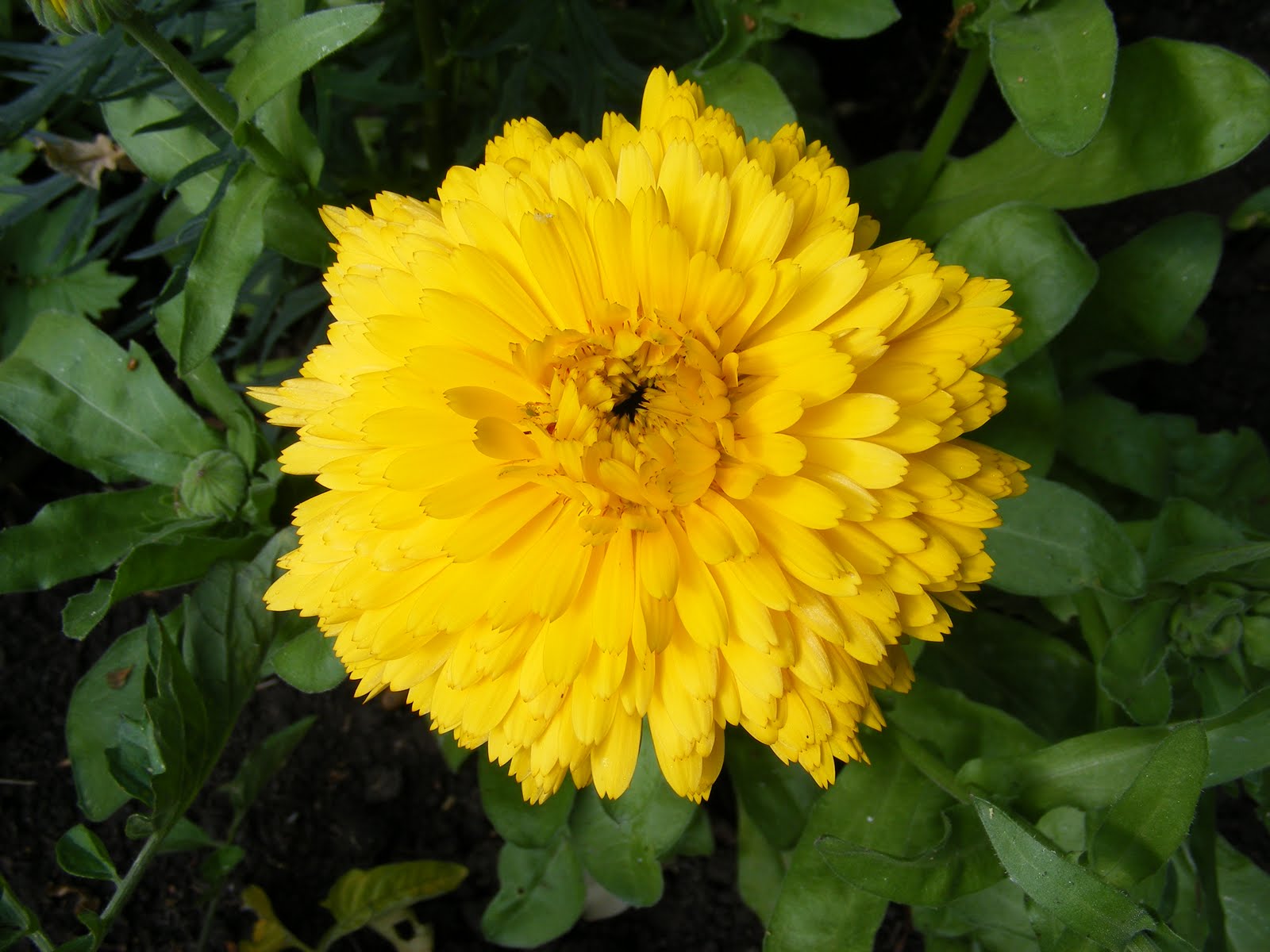
Calendula


  What bright reflections of sunlight these little common marigolds are. They have been opening their buds since early May in my little patch, and if deadheaded regularly they will continue flowering all summer long. Hence its Latin title Calendula officianalis, inferring that if given the right circumstances, it can push forth flowers in every month of the calendar,
According to  A Niewe Herball of 1578
   ‘It hath pleasant bright and shining yellow flowers, which do close at the setting downe of the sunne, and do spread and open againe at the sunne rising.’(in Mrs Grieve)
 However others disagree and place a limit on opening times, from nine in the morning till three in the afternoon, whatever the timing, it does appear to enjoy basking in sunlight, and I have not as yet taken the time to observe this phenomena in greater detail.
 Shakespeare included himself in the debate by indicating in the Winter’s Tale that ‘The Marigold that goes to bed wi’ th’ sun, And with him rises weeping.’
  The sun-like orange flowers appear to exude a rather sticky aromatic substance which when the petals are placed in oil, can be preserved. One of the little Collins Nature Guides Herbs and Healing Plants places its aroma as ‘rather unpleasant.’ As usual with such pronouncements, I disagree, however I am beginning to realise I may have a strange idea of the scent that delights. The same little book gives its flowering season as from ‘June-Sep’; not in my neck of the woods I hasten to add.  
 Its uses are given as ‘Antiseptic and antifungal,’ it can be taken internally to ‘stimulate the liver’, and ‘externally as a salve to promote healing on cuts, grazes and spots’, plus ‘a gargle for mouth and throat infections.’ The active ingredients are given as ‘Essential oil, saponins, bitters, carotenoids,’ and ‘flavonoids.’  It appears that the flowers have been put to an assortment of uses, as ‘Formerly its flowers were used to give cheese a yellow colour.’(Mrs Grieve) and according to Macer’s Herbal (Mrs Grieve) one only has to look upon the flowers and it will ‘draw evil humours out of the head and strengthen the eyesight.’ It certainly fills my eyes with joy and removes any sign of an ‘evil humour.’ Macer adds ‘Ye odour of ye golde is good to smelle.’ That’s good, at least someone agrees with me.  
  Culpeper places the plants unsurprisingly under the influence of the Sun and under Leo. This seems to gain the agreement of all others. Cunningham suggests its gender is masculine of the element fire. He give its powers as ‘Protection, Prophetic Dreams, Legal Matters, Physic Powers’ and adds as an end note ‘If a girl touches the petals of the marigold with her bare feet, she will understand the language of the birds.’  They are probably shouting, ‘get your great stinky feet off the flower beds, you are squashing the flowers.’ Catherine Yronwode indicates the blossoms are lucky in money matters as ‘they resemble coins.’
   Culpeper suggests that ‘the flowers either green or dried, are much used in possets, broths’ and as a ‘drink’; and  a ‘comforter of the heart and spirits’.  He also adds it can be used ‘to expel any malignant or pestilential quality which might annoy them.’ Good eh?, with marigold I can remove any ‘pestilential quality’ so as to comfort my heart and spirit. However he goes on to spoil the image by then mixing  the powdered dried flowers with ‘hog’s grease, turpentine and rosin’ then ‘applied to the breast; which ‘strengthens and succours the heart infinitely in fevers, whether pestilential or not.’ Hog’s grease or no hog’s grease, a very useful buddy to have in the plant world.


Wednesday, 1 June 2011

Thornapple (Datura Stramonium)

                                                                                                                                                            The Datura, Devil’s apple or Jimson weed is yet another member of the henbane family of the order of Solanceæ. There are as many as fifteen species in the genus Datura found in warmer places throughout the globe however it is the plant better known as the thornapple that I will be examining briefly here. This thornapple according to Mrs Grieve, emits ‘ a  rank, very heavy and somewhat nauseating narcotic odour. ’ (I rather like its aroma). ’The  fœtid odour arises from the leaves especially when they are bruised, but the flowers are sweet-scented, though producing stupor if their exhalations are breathed in for any length of time.’ I must say I did enjoy my dreams whilst the young plants were growing on my bedroom windowsill before finding their place outside. The white trumpet shaped flowers show themselves for most of the summer, opening in the evening they attract night flying moths with the fragrance they emit. Following the flowers there appears a large spiny egg shaped seed capsule, roughly the size of a large walnut.  These capsules, when ripe, turn brown and split into four to allow the many seeds to be dispersed.


   Mrs Grieve states that ‘In early times, the Thornapple was considered an aid to the incantation of witches,’ (she doesn’t say how) ‘and during the time of the witch and wizard mania in England, it was unlucky for anyone to grow it in his garden.’
  She also indicates that ‘It has been conjectured that’ its leaves were ‘used by the priests of Apollo at Delhi to assist them in their prophesies in the temple of the sun. ’She also indicates that the Peruvians made an ‘intoxicating beverage from the seeds which induces stupefaction and delirium if partaken of in large quantities.’
  Cunningham places this plant under the rulership of Saturn and the element water. He places its element as water, and indicates that it can be ‘used to break spells by sprinkling it around the home.’ I do suppose he means an infusion rather than sprinkling the seeds around. He also states that ‘If insomnia persists night after night, it may be cured by placing some datura leaves into each shoe and then setting the shoes under the bed, with the toes pointing toward the nearest wall.’
  Roaming over to Mexico, I thought I may add this little gem of information found in Witchcraft Medicine, Healing Arts, Shamanic Practices, and Forbidden Plants, where it appears one may still buy a salve called pomade de toloache, said to contain toloache the Mexican datura, following this statement is  the following quote;

 ‘It is very rare that a toloache salve from pork lard and datura leaves is still made in Mexico. There are still “witches” who sell their datura pomade, because it is supposed to make men superfluous. This is the exact counterpart of the witches’ salves of the Middle Ages which were made from henbane and thorn apple. (Schenk, 1954:79)

Hmm; maybe I see a new career on the horizon. ;-)